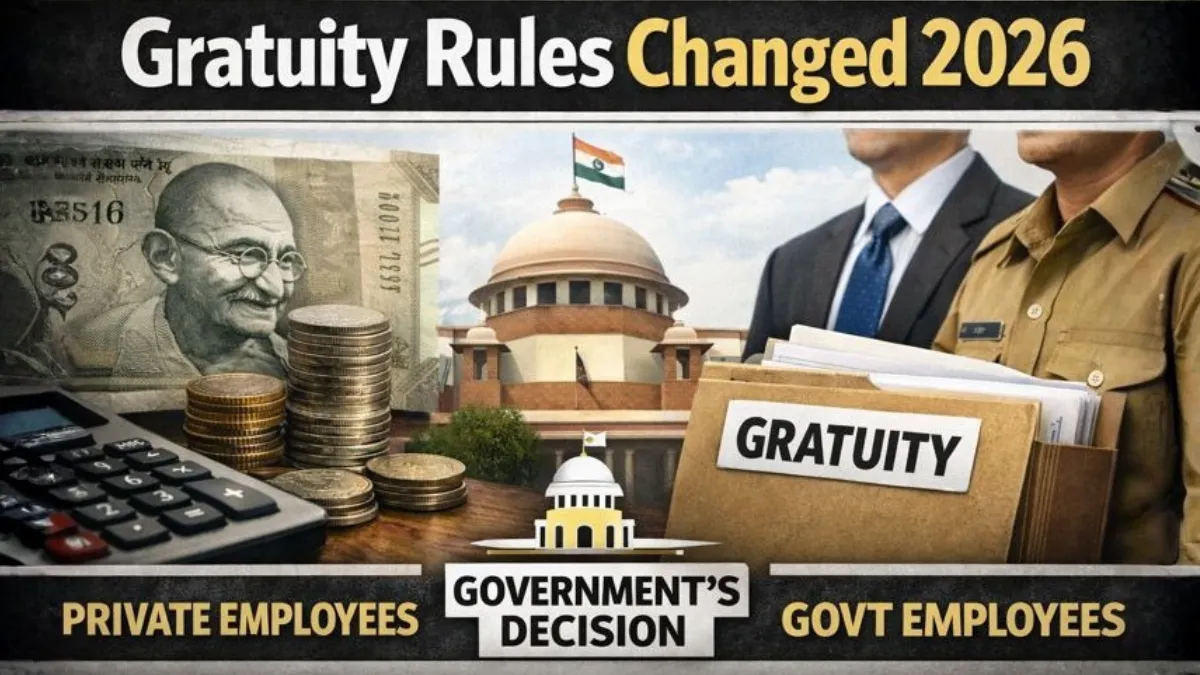
Gratuity New Rules 2026: Gratuity is one of the most trusted financial benefits for employees in India. It represents years of hard work and long-term commitment to an organization. As discussions around the Gratuity New Rules 2026 grow stronger, both private and government employees are closely watching every update. These proposed changes are expected to improve fairness, expand coverage, and modernize gratuity benefits to match today’s work culture and salary structures.
Gratuity Rules Under Major Review
The government is seriously reviewing existing gratuity rules to make them more relevant in 2026. Current laws were framed when job stability was higher and career paths were more predictable. Today, employees switch jobs more frequently and work under varied employment models. The new review focuses on aligning gratuity benefits with modern employment realities while protecting employee interests across both public and private sectors.
Eligibility Conditions May Get Easier
One of the biggest talking points is the five-year continuous service rule. Under the proposed changes, this condition may be relaxed for certain employees. Fixed-term workers, contract staff, and professionals with structured short-term roles could become eligible for gratuity benefits. This step would acknowledge service contribution even when employment is not traditionally long-term, offering relief to millions of private sector employees.
Gratuity Calculation Could Change
The gratuity calculation method may also be updated in 2026. Currently, it is based mainly on the last drawn salary, which can sometimes create imbalance. The government is considering formulas that use average salary or revised wage definitions. This approach could make gratuity payouts more balanced and transparent, especially for employees with fluctuating income or recent promotions.
Higher Gratuity Limit On Cards
With rising inflation and higher salaries, the existing gratuity ceiling often feels outdated. The government is expected to review the maximum gratuity limit again in 2026. An increased limit would directly benefit senior employees and long-serving professionals. This move would ensure that gratuity remains a meaningful financial support rather than a symbolic retirement benefit.
Big Impact Expected For Private Employees
Private sector employees are likely to feel the strongest impact of the new gratuity rules. Flexible job structures and performance-based pay are common in private companies. If eligibility and calculation rules are expanded, more private employees could receive higher gratuity amounts. At the same time, companies may need to improve compliance and financial planning to meet these updated obligations.
What Government Employees Should Know
For government employees, gratuity continues to be a key retirement component. The 2026 rules may bring better uniformity between central and state services. Faster digital processing and clearer service records are also expected to reduce delays in gratuity payments. Any revision in pay scales or service benefits will directly reflect in the final gratuity amount for retiring employees.
Tax Rules May Become Clearer
Taxation on gratuity is another area under focus. While government employees currently enjoy full tax exemption, private employees face limits. The new rules may aim to simplify tax treatment and raise exemption thresholds. Clear and updated tax guidelines would help employees plan their retirement funds more efficiently without confusion or last-minute tax stress.
Why These Changes Matter Long Term
Gratuity reforms in 2026 are not just about payouts but about financial dignity after service. With longer working lives and rising post-retirement expenses, gratuity needs to remain strong and reliable. These changes signal the government’s intent to modernize labor laws while balancing employee security and employer responsibility.
Final Word: Gratuity New Rules 2026
The Gratuity New Rules 2026 could bring one of the most important employee-friendly reforms in recent years. From relaxed eligibility to higher limits and clearer taxation, the proposed updates aim to strengthen financial security for millions of workers. While official notifications are still awaited, staying informed now will help employees prepare better for their financial future and retirement planning.